


How Storytelling Improves Speech Development

Storytelling is one of the simplest ways to help young children develop strong communication skills. Whether a child is listening to a favorite picture book, making up a story about a toy, or telling a parent what happened during the day, storytelling gives them valuable opportunities to listen, understand, remember, and use language.
For young children, speech development does not happen only through formal lessons. Everyday conversations, songs, books, pretend play, and storytelling can all create meaningful opportunities for children to practice communicating.
A child who regularly hears stories and gets opportunities to tell their own stories is exposed to new vocabulary, sentence structures, sounds, emotions, and ideas.
Over time, these experiences can help children become more confident and effective communicators.
What Is Storytelling?
Storytelling is the process of sharing events, ideas, experiences, or imaginary situations through spoken language. It can involve books, pictures, personal experiences, puppets, toys, or completely made-up stories.
For example, a preschool teacher might show children a picture and ask, “What do you think is happening here?” Children can then describe what they see and create their own story.
Parents can do something similar at home by asking children to explain what happened at the park, describe their favorite character, or make up a story about a stuffed animal.
These simple conversations encourage children to use language instead of simply listening to adults speak.
1. Storytelling Builds Vocabulary
One of the biggest benefits of storytelling is vocabulary development.
Children encounter words during stories that they may not hear during everyday conversations. Words such as “enormous,” “curious,” “adventure,” “disappointed,” or “exhausted” give children new ways to describe people, objects, actions, and emotions.
The more children hear meaningful words in context, the easier it can become for them to understand and eventually use those words themselves.
Parents and teachers can strengthen vocabulary development by briefly explaining unfamiliar words and then using them again in conversation.
For example:
“The rabbit was exhausted. Exhausted means very tired. After running all day, the rabbit was exhausted.”
This gives the child both the word and its meaning.
2. Storytelling Encourages Children to Speak in Sentences
Young children often begin with short phrases such as “Want juice” or “Doggie there.”
As their language develops, they gradually begin using longer and more detailed sentences.
Storytelling encourages this progression because children have to connect ideas.
Instead of saying:
“Dog.”
A child might eventually say:
“The dog ran into the garden because he wanted to find his ball.”
That longer sentence contains a subject, action, location, and reason.
When adults listen patiently and encourage children to expand their thoughts, storytelling can provide natural practice with sentence formation.
3. It Improves Listening Skills
Speech development is closely connected with listening.
Before children can effectively communicate their own ideas, they need to understand what other people are saying.
Listening to stories encourages children to pay attention to characters, events, conversations, and changes in the storyline.
Teachers can ask questions such as:
“What happened first?”
“Where did the character go?”
“Why was the boy sad?”
“What do you think will happen next?”
These questions encourage children to listen for details rather than simply hearing the story in the background.
4. Storytelling Helps Children Practice Pronunciation
Children need repeated opportunities to hear and use speech sounds.
Storytelling gives them a reason to repeat words and phrases naturally.
For example, a story about animals may include words such as “rabbit,” “roar,” “snake,” “sheep,” and “chicken.” Repeated exposure allows children to hear how words sound and practice saying them.
Parents should avoid making children feel embarrassed when they pronounce a word incorrectly. Instead, adults can model the correct pronunciation naturally.
If a child says, “I saw a tat.”
An adult can respond:
“Yes, you saw a cat! What was the cat doing?”
The child hears the correct sound without feeling pressured or criticized.
5. It Strengthens Narrative Skills
Narrative skills are a child's ability to tell about events in a logical and understandable way.
Children gradually learn that stories usually have a beginning, middle, and end.
For example:
“First, Sara went to the park. Then she found a butterfly. Finally, she went home and told her mom about it.”
This structure helps children organize their thoughts.
Narrative skills are useful far beyond storytelling. Children use them when explaining what happened at school, describing an experience, answering questions, and eventually writing stories.
6. Storytelling Supports Confidence
Some children are naturally comfortable talking in front of others, while others need more encouragement.
Storytelling can provide a safe way to build communication confidence.
A teacher might invite a child to tell a short story to a small group rather than asking them to speak in front of an entire classroom.
At home, parents can ask children to tell a family story during dinner or explain a drawing they created.
The goal is not perfect grammar. The goal is helping children feel that their ideas are worth sharing.
As children receive positive attention when they communicate, they may become more willing to participate in conversations.
7. It Helps Children Express Feelings
Stories give children opportunities to explore emotions.
A character might feel happy, nervous, frustrated, excited, lonely, or proud. Adults can use these moments to help children identify and describe emotions.
For example:
“How do you think the character felt when her friend left?”
“Have you ever felt that way?”
“What could the character say to her friend?”
These conversations help children develop emotional vocabulary while practicing speech.
Being able to name emotions can also make it easier for children to communicate their needs.
Instead of crying without explaining why, a child may eventually be able to say, “I am upset because my friend took my toy.”
8. Storytelling Encourages Conversation
Storytelling should not always be a one-way activity.
Adults can turn stories into conversations by asking questions and giving children time to respond.
After reading a book, try asking:
“What was your favorite part?”
“Which character did you like?”
“Why do you think she did that?”
“What would you have done?”
“What happens next?”
There may be no single correct answer to some of these questions. That is okay.
Open-ended questions encourage children to think, explain, and use their own words.
9. It Supports Early Literacy
Speech and language development provide an important foundation for later literacy.
When children listen to stories, talk about pictures, retell events, and create their own stories, they are learning how language works.
They begin noticing:
New vocabulary
Sentence patterns
Story sequences
Characters and settings
Beginning and ending sounds
Rhyming words
Cause and effect
Beginning, middle, and end
These skills can support children's transition toward reading and writing.
10. Storytelling Can Help Children Develop Memory
Retelling a story requires children to remember information.
They may need to remember:
Who was in the story?
Where did the story happen?
What happened first?
What happened next?
How did the story end?
When children practice retelling familiar stories, they are using memory while also organizing information into a meaningful sequence.
Parents can make this activity easier for younger children by using pictures as prompts.
For example, place three pictures in front of your child and ask them to explain what happened first, next, and last.
How Parents Can Encourage Storytelling at Home
You do not need special equipment or complicated activities to encourage storytelling.
Try some of these simple ideas.
Read Together Every Day
Choose age-appropriate books and read them aloud. Pause occasionally to discuss the pictures and characters.
You do not need to finish every sentence without interruption. Conversation is part of the experience.
Let Your Child Retell a Familiar Story
After reading the same book several times, ask your child to tell the story back to you.
Let them use their own words. Their version does not have to match the book exactly.
Use Pictures
Show your child a picture and ask:
“What is happening?”
“Who is there?”
“What do you think happened before this?”
“What will happen next?”
This can be especially useful for children who are still developing confidence with longer sentences.
Create Stories With Toys
Use dolls, stuffed animals, blocks, or toy vehicles.
You might say:
“Your teddy bear is going on a trip. Where is he going?”
Then allow your child to continue the story.
Talk About Daily Experiences
Storytelling does not always need to involve imaginary characters.
Ask your child to describe their day.
“What did you do outside?”
“Who did you play with?”
“What was your favorite activity?”
“What made you laugh today?”
These questions encourage children to practice describing real experiences.
How Childcare Programs Can Support Speech Development
A quality early childhood program can incorporate storytelling throughout the day.
Teachers can use picture books, songs, puppets, dramatic play, group conversations, and story-retelling activities to encourage children to communicate.
If you are comparing daycare houston programs, ask how teachers support language and communication development.
During a tour, parents can ask:
How often do teachers read to children?
Do children have opportunities to retell stories?
Are children encouraged to ask questions?
How are new vocabulary words introduced?
Do teachers use songs, puppets, and dramatic play?
How do teachers encourage shy children to participate?
These questions can help you understand whether language development is part of the everyday classroom experience.
Storytelling for Children of Different Ages
Storytelling can be adapted to suit a child's developmental level.
Infants
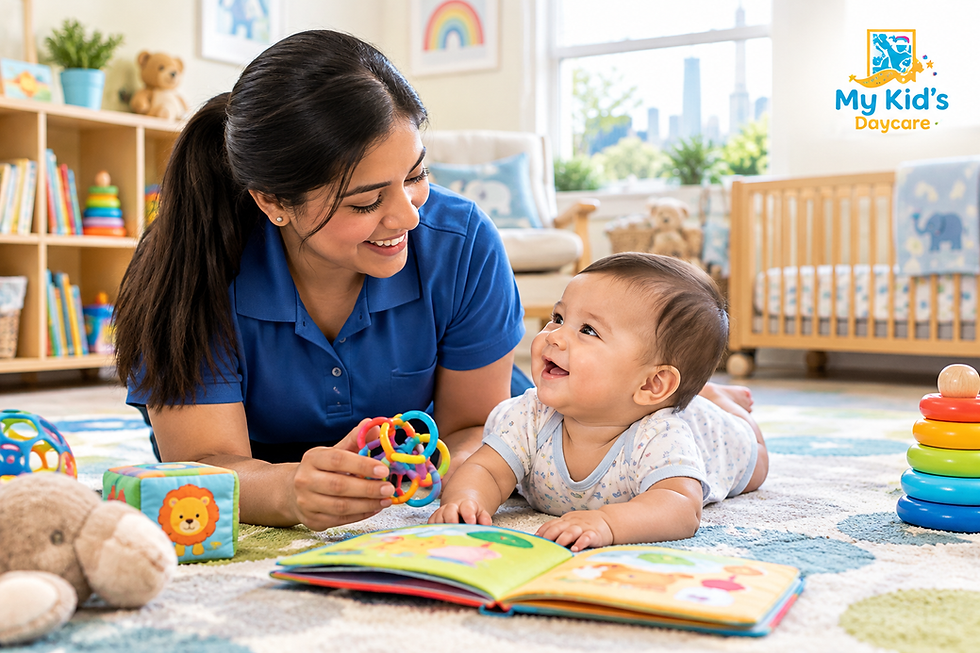
For babies, storytelling can focus on listening and interaction. Read simple picture books, point to pictures, make expressive sounds, and respond to your baby's reactions.
Toddlers
Toddlers can name objects, complete familiar phrases, identify characters, and answer simple questions.
Try asking, “Where is the dog?” or “What is the baby doing?”
Preschoolers
Preschoolers can begin creating longer stories, retelling familiar events, predicting outcomes, and describing characters.
Encourage them to explain not only what happened but also why it happened.
School-Age Children
Older children can create more detailed stories with characters, settings, problems, solutions, and endings.
They can also experiment with different storytelling styles and vocabulary.
When Should Parents Be Concerned About Speech Development?
Every child develops language at their own pace. However, parents who have concerns about a child's speech, understanding, or ability to communicate should discuss those concerns with the child's pediatrician or a qualified speech-language professional.
A childcare teacher may also notice communication patterns that parents can discuss with a professional.
Early support can be helpful when a child does need additional assistance.
Parents do not need to wait until a child enters elementary school to ask questions about speech development.
Choosing a Childcare Program That Encourages Communication
Families searching for childcare may compare programs based on location, schedule, cost, curriculum, and classroom environment.
If you are searching for an affordable daycare, remember to look at the learning experiences included in the daily routine as well as tuition.
Families interested in financial assistance may also search for NCI daycare near me and ask providers whether they accept NCI assistance and what enrollment requirements apply.
A strong early learning environment should give children regular opportunities to talk, listen, ask questions, tell stories, interact with classmates, and communicate with caring adults.
Frequently Asked Questions
How does storytelling improve speech development?
Storytelling exposes children to vocabulary, sentence structures, sounds, and conversations. It also encourages them to practice speaking, organize their thoughts, and explain ideas.
Can storytelling help a child speak in longer sentences?
Yes. When children describe characters, events, and experiences, they naturally have opportunities to connect words and ideas into longer sentences.
Does reading stories help speech development?
Reading aloud gives children repeated exposure to language, vocabulary, sentence patterns, and sounds. Discussing the story afterward provides additional opportunities for children to practice speaking.
How often should parents read stories to children?
Reading regularly is beneficial. Even a short daily reading routine can create valuable opportunities for listening, conversation, vocabulary building, and bonding.
What if my child does not want to tell stories?
Do not pressure them. Start with simple questions about pictures, toys, or everyday experiences. As children become more comfortable, they may naturally begin sharing longer responses.
Help Your Child Build Strong Communication Skills
Looking for a childcare environment where your child can develop language, confidence, and communication skills through stories, conversations, and engaging activities? At My Kid’s Daycare, children have opportunities to learn, explore, interact, and express themselves in a supportive environment.
Visit us: 12280 Westheimer Rd, Suite 50, Houston, TX 77077
Call: (281) 760-1951
Come see us and take a tour! Contact us today to learn more about our infant, toddler, preschool, and after-school programs.


Comments