


Why Is My Child Suddenly Talking More After Starting Daycare?
Updated: Sep 4

Have you noticed that your child suddenly has more to say after starting daycare? Maybe they are telling you about their day, naming new objects, asking more questions, singing songs, or using words you have never heard them say before.
This kind of change can be exciting for parents, and it is often a sign that your child is gaining confidence through everyday social and learning experiences.
Daycare provides children with opportunities to communicate with teachers, interact with other children, participate in group activities, and practice new vocabulary throughout the day.
A consistent environment can encourage children to express their thoughts and feelings more comfortably.
For families looking for quality early childhood care, understanding how daycare supports communication development can make choosing the right program much easier.
How Does Daycare Encourage Children to Talk More?
Children learn language through repeated interactions. At daycare, they are surrounded by teachers and classmates who naturally create opportunities for conversation.
A typical day may include greetings, circle time, storytime, songs, pretend play, meals, outdoor activities, and group discussions. Each experience gives children a reason to listen, respond, ask questions, and use new words.
Teachers also model appropriate language by talking with children throughout the day.
Instead of simply giving instructions, educators may ask questions such as, “What are you building?” or “How do you think we can fix it?” These simple conversations encourage children to think and respond using language.
1. More Social Interaction Builds Communication Skills
One of the biggest differences between home and daycare is the amount of social interaction children experience.
At daycare, children communicate with peers of different personalities and ages. They learn how to:
• Ask for a toy• Join a game• Tell another child what they want• Take turns speaking• Listen to others• Express emotions• Solve small disagreements• Ask teachers for help
These everyday interactions provide valuable practice. Children may initially use only a few words, but regular social experiences can gradually encourage longer conversations.
2. Structured Activities Create Opportunities to Communicate
A daycare with structured activities gives children predictable opportunities to use language throughout the day.
Circle time, for example, may involve talking about the weather, discussing the day’s activities, singing songs, or listening to a story. Learning centers may encourage children to describe what they are building, drawing, pretending, or exploring.
Structured activities are especially useful because children are not expected to learn communication skills through one lesson alone. Instead, language becomes part of their normal routine.
When children repeatedly hear and use words in meaningful situations, they can become more comfortable expressing themselves.
3. Storytime Introduces New Vocabulary
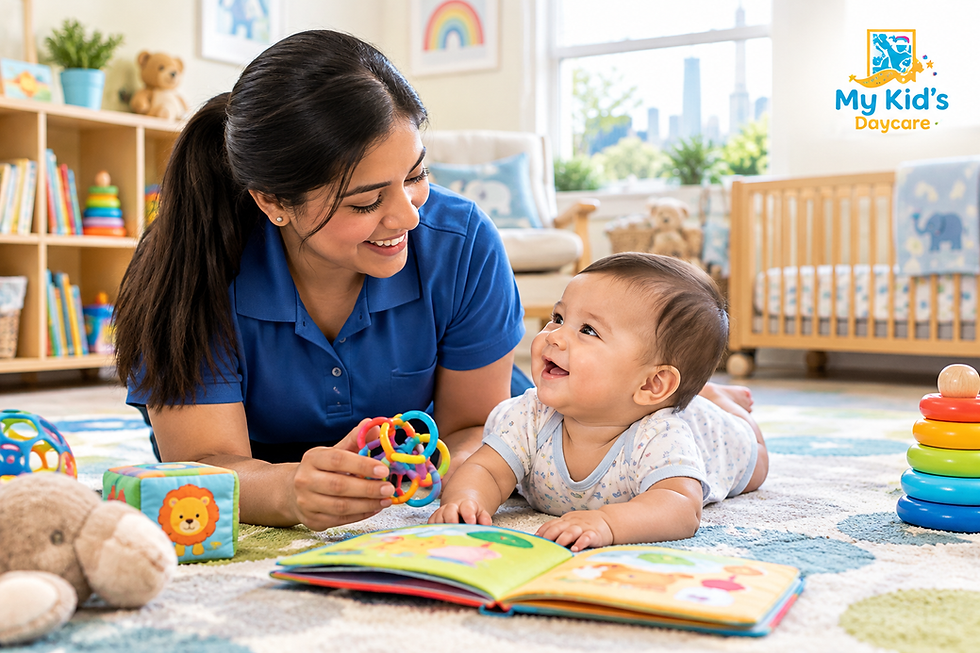
Books are one of the simplest ways to expand a young child's vocabulary.
During storytime, children hear words that may not come up during everyday conversations. Teachers can explain unfamiliar words, ask questions about pictures, and encourage children to predict what might happen next.
For example, instead of simply reading a story, a teacher might ask:
“What do you think the bear will do next?”
“Why does the character look sad?”
“What color is the house?”
Questions like these encourage children to listen carefully and respond.
Over time, children may begin using some of these new words at home.
4. Songs and Music Encourage Language Development
Songs, rhymes, and music naturally encourage children to practice sounds and words.
Repeating familiar songs helps children remember vocabulary and sentence patterns. Rhymes can also help children become aware of sounds in language.
Activities such as singing the alphabet, counting songs, movement songs, and simple nursery rhymes can make language practice enjoyable rather than stressful.
This is one reason parents may notice their child singing or repeating phrases after spending time at daycare.
5. Pretend Play Helps Children Express Ideas
Pretend play is another important part of communication development.
Children may pretend to be doctors, teachers, parents, cooks, firefighters, or shopkeepers.
During this type of play, they create conversations and use language to explain what is happening.
For example, a child pretending to be a doctor may say, “You need medicine,” or “Where does it hurt?”
These simple conversations allow children to practice vocabulary, storytelling, imagination, and social communication at the same time.
6. Teachers Encourage Children to Use Their Words
Teachers can have a major influence on a child's communication confidence.
When educators patiently listen to children and give them time to answer, children learn that their words matter. Teachers may also expand on what a child says.
If a child says, “Big truck,” a teacher might respond, “Yes, that is a big blue truck.”
This gives the child an example of how short phrases can become longer sentences.
Positive encouragement can also help children who are naturally quiet become more willing to participate.
7. Playing With Other Children Builds Confidence
Children often communicate differently with their peers than they do with adults.
When they play together, they need to negotiate, share ideas, solve problems, and understand one another. These situations can encourage children to communicate independently.
A child who rarely speaks at home may become more talkative after developing friendships at daycare. They may have stories to tell about their friends, games they played, or activities they completed.
That increased desire to share experiences can lead to more conversations at home.
Why Does My Child Talk So Much After Daycare?
Parents sometimes notice that their child becomes especially talkative after returning home.
This may happen because daycare gives them a full day of experiences to process. They may want to tell you about a friend, activity, book, song, meal, playground experience, or classroom project.
You may hear statements such as:
“Today we painted!”
“I played with Sarah.”
“We read a dinosaur book.”
“I made a tower.”
These conversations provide parents with a window into their child's day and show how children are beginning to organize and communicate their experiences.
Does Daycare Improve Speech and Language Skills?
Daycare can provide many opportunities for children to practice communication, but every child's development is different.
Children develop language at different rates. Some children are naturally talkative, while others prefer to listen before participating. A quiet child may still be learning important communication skills even when they do not speak frequently.
A quality childcare environment can support development by providing regular opportunities for children to hear language, interact with others, participate in activities, and express themselves.
Parents should also remember that daycare is only one part of a child's language environment. Conversations, reading, singing, and play at home are equally valuable.
How Parents Can Encourage More Talking at Home
If your child has become more talkative after starting daycare, encourage those conversations.
Instead of asking only, “Did you have a good day?” try asking specific open-ended questions.
You can ask:
“What was your favorite activity today?”
“Who did you play with?”
“What story did your teacher read?”
“What did you build?”
“What made you laugh today?”
You can also read together, sing songs, play pretend games, and encourage your child to describe pictures or tell stories.
Most importantly, give your child time to answer. Avoid finishing their sentences too quickly. Listening patiently shows children that their ideas and words are important.
Choosing the Right Daycare for Your Child
When comparing childcare options, parents should consider more than location and cost. Look for a program that provides a safe, welcoming environment with opportunities for social interaction, learning, creativity, and communication.
A quality program may include age-appropriate learning centers, storytime, music and movement, outdoor play, STEM activities, role play, and peer interaction.
For families searching for affordable daycare, it is also important to ask about tuition, schedules, available programs, and whether the center participates in financial assistance programs that may be available to eligible families.
At my kids daycare, children can participate in a daily routine that includes circle time, storytime, music and movement, role play, learning centers, outdoor play, STEM activities, and supervised play.
These experiences give children many opportunities to learn, socialize, explore, and communicate.
When Should Parents Be Concerned About Speech Development?
Increased talking is generally an encouraging change, but parents may still have questions about their child's overall communication development.
If your child seems to have difficulty understanding simple communication, rarely responds to their name, loses language skills they previously had, or you have ongoing concerns about their speech or communication, talk with your child's pediatrician or a qualified speech and language professional.
Every child develops differently, so professional guidance can help determine whether additional support would be beneficial.
Frequently Asked Questions
Why does my child talk more after starting daycare?
Your child may be getting more opportunities to communicate through conversations with teachers, interactions with classmates, storytime, songs, pretend play, and structured classroom activities.
These experiences can increase vocabulary and communication confidence.
Does daycare help children develop language skills?
Daycare can provide frequent opportunities for children to listen, speak, ask questions, interact with peers, and learn new vocabulary. A supportive environment can complement language development at home.
What daycare activities encourage children to talk?
Storytime, circle time, music, role play, pretend play, learning centers, group discussions, and peer activities can all encourage children to communicate.
Is a daycare with structured activities better for language development?
Structured activities can provide predictable opportunities for communication throughout the day. The most important factor is that activities are age appropriate, engaging, and supported by responsive teachers.
How can parents encourage their child to talk more at home?
Read books together, ask open-ended questions, talk about daily experiences, sing songs, play pretend games, and give your child enough time to answer without interrupting.
Should I be worried if my child is quiet at daycare?
Not necessarily. Some children need more time to become comfortable in a new environment. Talk with teachers about your child's participation and communication. If you have ongoing developmental concerns, discuss them with your child's pediatrician.
What should I look for when choosing daycare in Houston?
Parents should consider safety, cleanliness, teacher-child interactions, age-appropriate activities, daily routines, communication with families, learning opportunities, and whether the program fits their child's individual needs.
Can affordable daycare still provide learning opportunities?
Yes. Cost does not automatically determine the quality of a childcare program.
Parents should compare programs based on safety, staff, activities, curriculum, environment, communication, and the overall experience provided to children.
Ready to Find the Right Daycare for Your Child?
Choosing the right childcare program can give your child valuable opportunities to learn, communicate, make friends, and build confidence.
At My Kid’s Daycare, children enjoy age-appropriate learning, social interaction, creative play, storytime, outdoor activities, STEM activities, and more in a caring environment.
Schedule a tour today and come see how our programs can support your child’s growth and development.
Adress: 12280 Westheimer Road, Suite 50, Houston, TX 77077
Phone: (281) 760-1951
Come visit us and discover a daycare where your child can learn, explore, and grow with confidence!


Comments